


CHAD GRAY'S 30 YEARS OF MADNESS: THREE DECADES, TWO LEGACIES, AND A NIGHT THAT BELONGED TO THE FANS
Chad Gray | Butcher Babies | Kissing Candice | Devil's Cut
at Fremont Country Club Las Vegas
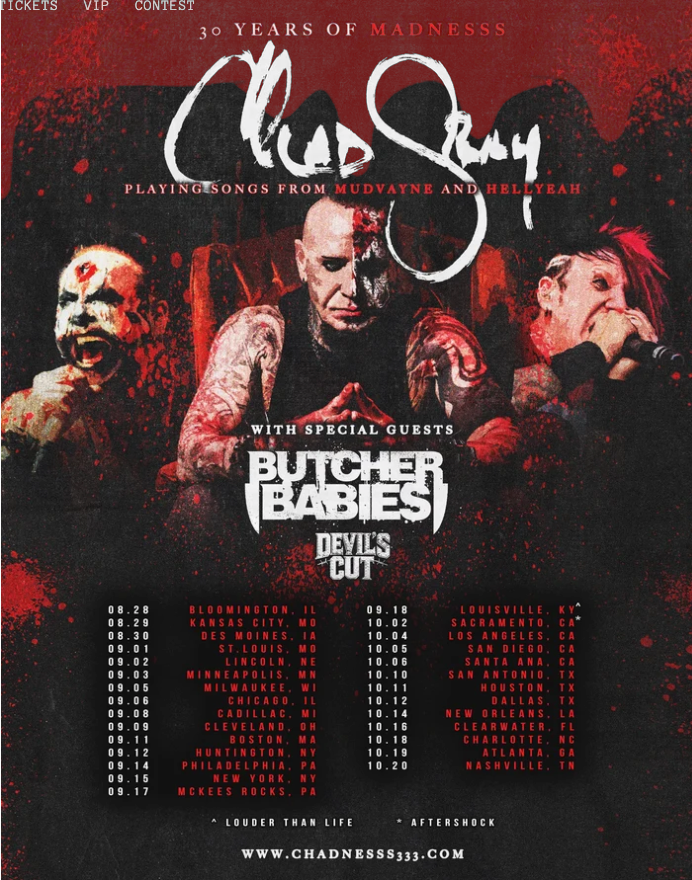
Thirty years of madness, two influential metal bands, one temperamental set of vocal cords, and a Wednesday night in downtown Las Vegas. On paper, Chad Gray's 30 Years of Madness Tour had all the ingredients for an evening of nostalgia and musical aggression.
However, the days leading up to the October 7 performance introduced an unexpected complication. Gray had canceled two Southern California appearances following an injury to his vocal cords, leaving fans wondering whether Las Vegas would suffer the same fate. Fortunately, Gray received clearance to perform, and Fremont Country Club welcomed a four-band lineup featuring Devil's Cut, Kissing Candice, Butcher Babies, and the man whose voice has accompanied three decades of heavy music.
Attendance was lighter than expected, although you wouldn't have known it from the enthusiasm gathering near the stage. There were noticeable gaps throughout the room, but those who showed up seemed determined to compensate for everyone who hadn't. Fremont Country Club's intimate layout worked in the bands' favor, creating an atmosphere where the distance between performer and audience practically disappeared. I've attended enough concerts to know that a sold-out room doesn't guarantee an engaged crowd. Sometimes, a few hundred committed metalheads can generate more energy than an arena full of casual observers. Wednesday night offered a convincing argument for exactly that.
Kentucky's Devil's Cut opened the evening with a sound that blended contemporary hard rock, melodic hooks, and an unmistakable Southern character. There was something distinctly regional about their approach, particularly in the vocal delivery and the way their melodies balanced accessibility with heavier arrangements. Their nine-song performance moved through tracks including "Drop Dead" and "Drink With the Devil," (from their debut album Roadkill on MNRK), "Backfire," and "Welcome to Kentucky," allowing the band to introduce themselves without relying on theatrical distractions. Their stage presence was confident, and they made a conscious effort to engage an audience still settling into the evening.
Between songs, they acknowledged Chad Gray and expressed genuine appreciation for being invited onto the tour. It was a small gesture, perhaps, but one that reflected their understanding of the opportunity. Opening bands often carry the responsibility of establishing the night's momentum without the benefit of an established relationship with the audience. Devil's Cut handled that responsibility well, leaving the stage having accomplished considerably more than simply warming it up.
Kissing Candice, on the other hand, appeared determined to dismantle whatever sense of order Devil's Cut had established. I'd heard their name repeatedly over the past few years, yet somehow managed to miss every previous opportunity to photograph them. That unfortunate streak finally ended in Vegas, and within minutes, I was wondering what the hell had taken me so long.
Their appearance alone suggested that subtlety wasn't part of the evening's agenda. Elaborate masks, unsettling imagery, aggressive movement, and a relentless performance style created something resembling the chaotic atmosphere of early Slipknot, filtered through the rhythmic experimentation of Mudvayne and modern industrial-influenced metal. There was something delightfully disgusting about the entire presentation, and I mean that as a compliment. Beneath the visual madness, however, was a band with considerable musical discipline. The riffs were tight, the arrangements balanced melody with aggression, and the performers seemed entirely committed to the spectacle they had created.
I'll acknowledge that I wasn't especially familiar with Kissing Candice's catalog before the show. Afterward, I revisited their recordings and compared several tracks against what I remembered hearing, although I couldn't establish an exact setlist with confidence, What stayed with me wasn't a particular song title but the band's command of the stage. Their frontman also paused to explain that Chad Gray was one of their idols, adding an unexpectedly personal dimension to the performance. Suddenly, the Mudvayne influence carried a little more context.
There is something genuinely satisfying about watching musicians perform alongside the people who helped shape their musical identities. Kissing Candice delivered one of the evening's most memorable performances.
By the time Butcher Babies took the stage, the audience had settled into a comfortable rhythm of raised horns, movement, and increasingly enthusiastic participation. I've followed this band for years, having seen them perform numerous times and accumulated more than a little merchandise along the way.
Heidi Shepherd remains an engaging frontwoman, commanding attention through physical movement, vocal aggression, and her ability to connect with the audience. Songs such as "Red Thunder," "Monsters Ball," "It's Killin' Time, Baby!," "Spittin' Teeth," and "Magnolia Blvd." demonstrated the band's ability to move between driving grooves and more confrontational material. Their performance was energetic, their musicianship was solid, and the audience responded accordingly. Still, as someone familiar with their earlier performances, I couldn't entirely ignore the absence of the original dual-vocal arrangement. That chemistry contributed significantly to my appreciation of the band, and its absence remains noticeable to me. This isn't a criticism of anyone's personal decisions or an invitation to revisit the circumstances surrounding the lineup change. Rather, it's an acknowledgment that longtime listeners sometimes experience a band's evolution differently from newer audiences. Someone discovering Butcher Babies that evening witnessed an excellent performance. I enjoyed it too, although my history with their music inevitably shaped the experience.
What impressed me most about Butcher Babies, however, occurred between the music. The band invited a fan onto the stage to sign their bass drum, continuing a tradition that allows an audience member at each stop to leave a personal mark on the tour. The woman, whose name I believe was Rebecca, had recently gotten a Butcher Babies tattoo on her forearm and proudly showed it to Shepherd. Rather than rushing through the interaction, the band gave her time to enjoy the experience, pose for photographs, and share a meaningful moment with musicians she clearly admired. It was a simple demonstration of how artists can make an individual feel valued within a much larger community.
Shepherd also spoke about an emotionally difficult period in 2019 and the experiences that influenced her songwriting. Her willingness to discuss mental health introduced a more reflective tone to the evening, one that would return during Chad Gray's performance. Heavy music frequently explores pain, isolation, and personal conflict, but hearing artists discuss those experiences directly gives the songs another dimension. Some of these experiences inspired the new Butcher Babies record Nightbloom (Judge and Jury Records) that was released the week prior to this show, and the new record reflects a newer direction and maturity in the band's music.
Then came Chad Gray, a musician whose work with Mudvayne and HELLYEAH has occupied a considerable amount of space in my musical history. I've followed both bands for years and had the opportunity to experience their performances firsthand.
For those of us who came of age during metal's evolution through the 1990s and early 2000s, Gray's voice is immediately recognizable. His ability to shift between melodic phrasing, guttural aggression, and emotionally charged screams helped establish a distinctive identity across two very different bands. That history made his recent vocal injury particularly concerning. Heading into the evening, I wondered whether returning so quickly might compromise the performance or, worse, aggravate the condition that had already interrupted the tour.
Those concerns began to disappear as the band launched into HELLYEAH's "Moth," followed by Mudvayne's "Happy?" and "Hellyeah!" The opening sequence established the evening's central idea: this wasn't simply a retrospective of Gray's career but an opportunity to experience two musical legacies through the artist who connected them.
The performance moved comfortably between HELLYEAH's groove-driven aggression and Mudvayne's more intricate arrangements. "Death Blooms," "Hush," "Nothing to Gein," "Dull Boy," and "Say When" provided opportunities for the musicians to demonstrate their range, while selections including "-1," "Scream With Me," "Not Falling," and "Love Falls" offered contrasting emotional textures. Gray's backing musicians (Marcus Rafferty, Devin Attard, Nick Villarreal, Joe Bonasorte) performed with impressive cohesion, delivering muscular guitar tones, precise rhythms, and arrangements that respected the original recordings without sounding like simple imitations. Most importantly, Gray's voice held up remarkably well. The guttural passages carried weight, his higher screams retained their intensity, and the melodic sections revealed the familiar character that made those recordings memorable.
Whether every note came effortlessly is something only Gray could answer, but from where I stood, there was little indication that the audience was witnessing a compromised performance. Instead, we were watching a veteran musician navigate a demanding set with the determination that has defined much of his career.
Among the evening's highlights was Gray's remembrance of Vinnie Paul Abbott, the late Pantera and HELLYEAH drummer whose musical influence continues to resonate throughout the metal community. Gray described the creative process behind their songwriting, explaining how unfinished compositions often carried temporary names or numerical identifiers before developing into recognizable songs. He recalled Vinnie enthusiastically presenting a particularly aggressive drum arrangement, eager to share what he'd created with the rest of the band. The story eventually led to Gray encouraging the audience to join him in a thunderous chant of "HELLYEAH, motherfuckers!" It was an entertaining moment, but the sentiment beneath it carried greater significance.
For fans who never had the opportunity to experience HELLYEAH with Vinnie behind the drum kit, these recollections offer a connection to a musician whose presence helped define the band's identity. As a longtime Pantera and HELLYEAH fan, hearing Gray speak about his friend with such affection was one of the evening's most meaningful experiences. The stories remain even when the musicians who helped create them are gone.
As the performance progressed, Gray continued sharing personal reflections about his career, his struggles with mental health, and the relationship he maintains with the people who support his music. He spoke candidly about periods when suicide had entered his thoughts and described how music and his connection to the metal community helped him continue forward. There was no attempt to disguise the seriousness of those experiences behind theatrical language. Instead, Gray addressed the audience with a vulnerability that contrasted sharply with the aggression of his performance.
I've always appreciated musicians who recognize that their audiences are more than ticket sales or streaming statistics. Gray has consistently demonstrated an understanding of the relationship between artists and listeners, particularly those who have found some measure of belonging through heavy music. If the metal community ever needed another ambassador, I'd argue that Chad Gray has earned consideration. Sorry, Jose, but I'm giving Chad a few extra points on this one.
Near the conclusion of the evening, Gray abandoned the usual distance between performer and audience, crowd-surfing among the fans before taking time to shake hands with those gathered near the stage. It was a fitting conclusion to a performance built as much around personal connection as musical history.
The crowd might not have filled Fremont Country Club, but the enthusiasm never suggested that the musicians were performing to a diminished audience. The fans sang, shouted, reached toward the stage, and responded to Gray's stories with the familiarity of people who had spent years listening to those same recordings. Watching that exchange, I was reminded that the significance of a concert isn't necessarily measured by attendance figures. Sometimes, its value comes from the shared understanding between musicians and the people who have followed them through different chapters of their lives.
Thirty years in heavy music represents more than longevity. It reflects the ability to adapt, endure personal challenges, survive industry changes, and continue creating something that resonates with listeners.
Devil's Cut introduced the evening with melodic Southern character, Kissing Candice demonstrated the influence of an earlier generation through their own unsettling creativity, and Butcher Babies balanced musical aggression with genuine moments of connection.
Chad Gray ultimately brought those themes together through a performance that celebrated his past without ignoring the personal experiences that accompanied it. As someone who has followed his music for much of my adult life, I appreciated the opportunity to witness that history in an intimate setting.
Chad, if these words happen to find their way to you, thank you for three decades of music, for continuing to honor Vinnie Paul's memory, and for reminding the people who support you that their presence matters. The metal community is better for having you in it.
Stay safe, stay metal, and always be kind.
-- Rocky Kessinger
Watch photo Slideshows from Rocky Kessenger / Through The Metal Lens below...
Chad Gray photos Arnold "Rocky" Kessenger / Through The Metal Lens
Butcher Babies photos Arnold "Rocky" Kessenger / Through The Metal Lens
Kissing Candace photos Arnold "Rocky" Kessenger / Through The Metal Lens
Devil's Cut photos Arnold "Rocky" Kessenger / Through The Metal Lens
Comments